Budapest: Of Beauty and Scars
My thoughts on Budapest (or what little I've seen of it).
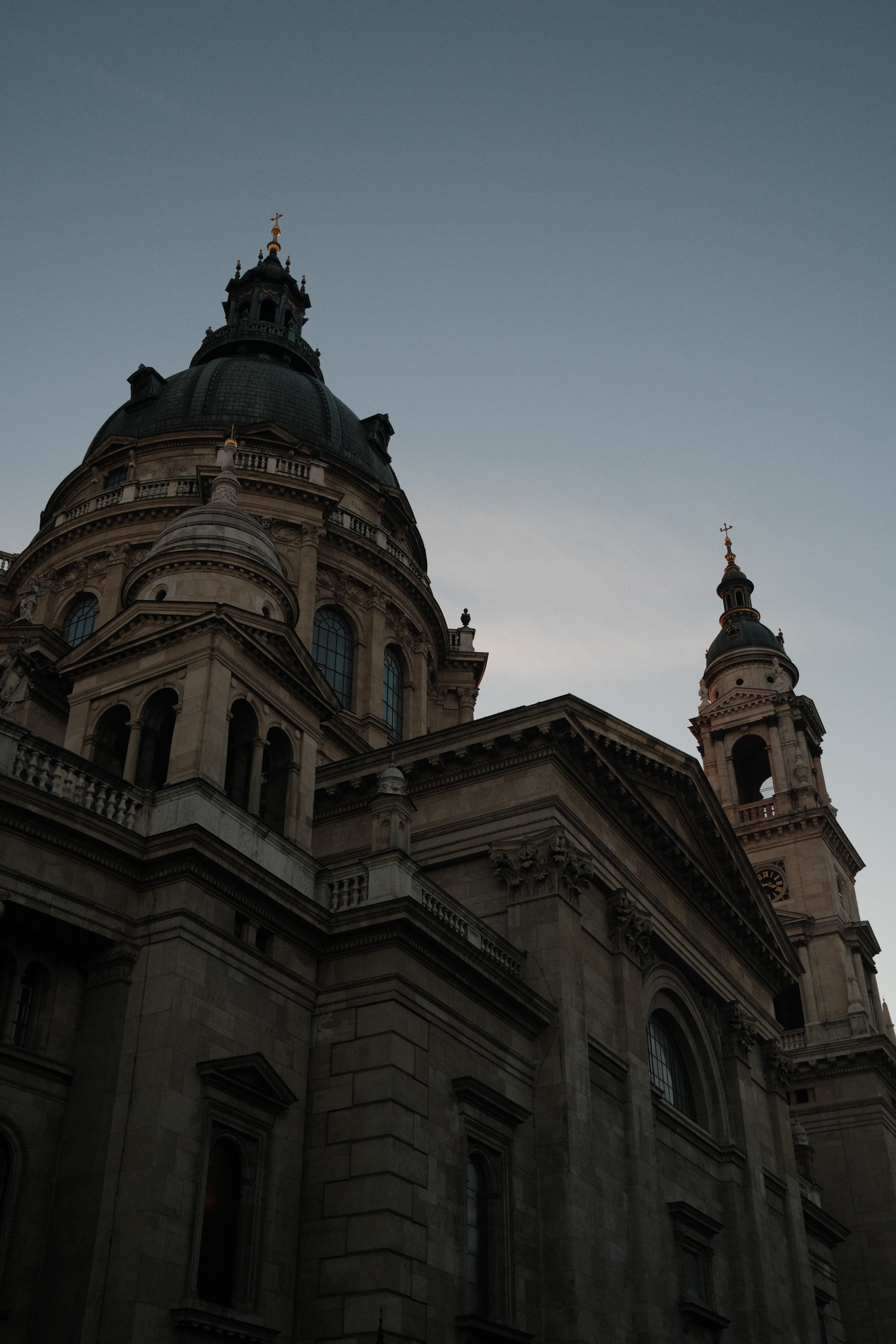
Dozens of times. This city has been under siege, attacked, pillaged, conquered, and occupied dozens of times. These seem to happen about every hundred years or so. We joked, “The time is nigh for the next one.” The last major assault was in 1945. The city still carries scars from that time — damaged architecture patched up with an almost fervent obsession of restoring these buildings to their former glory.
This city, however, has found a way to live with these scars. It relishes in the aftermath in the same way one may do so when his injury’s scab itches: by embracing discomfort, which signals that recovery is in progress. Though, considering the frequency that these things happen — like an athlete suffering his third injury of the week — this city has had a ton of (unwitting) training.
The Ruin Bars
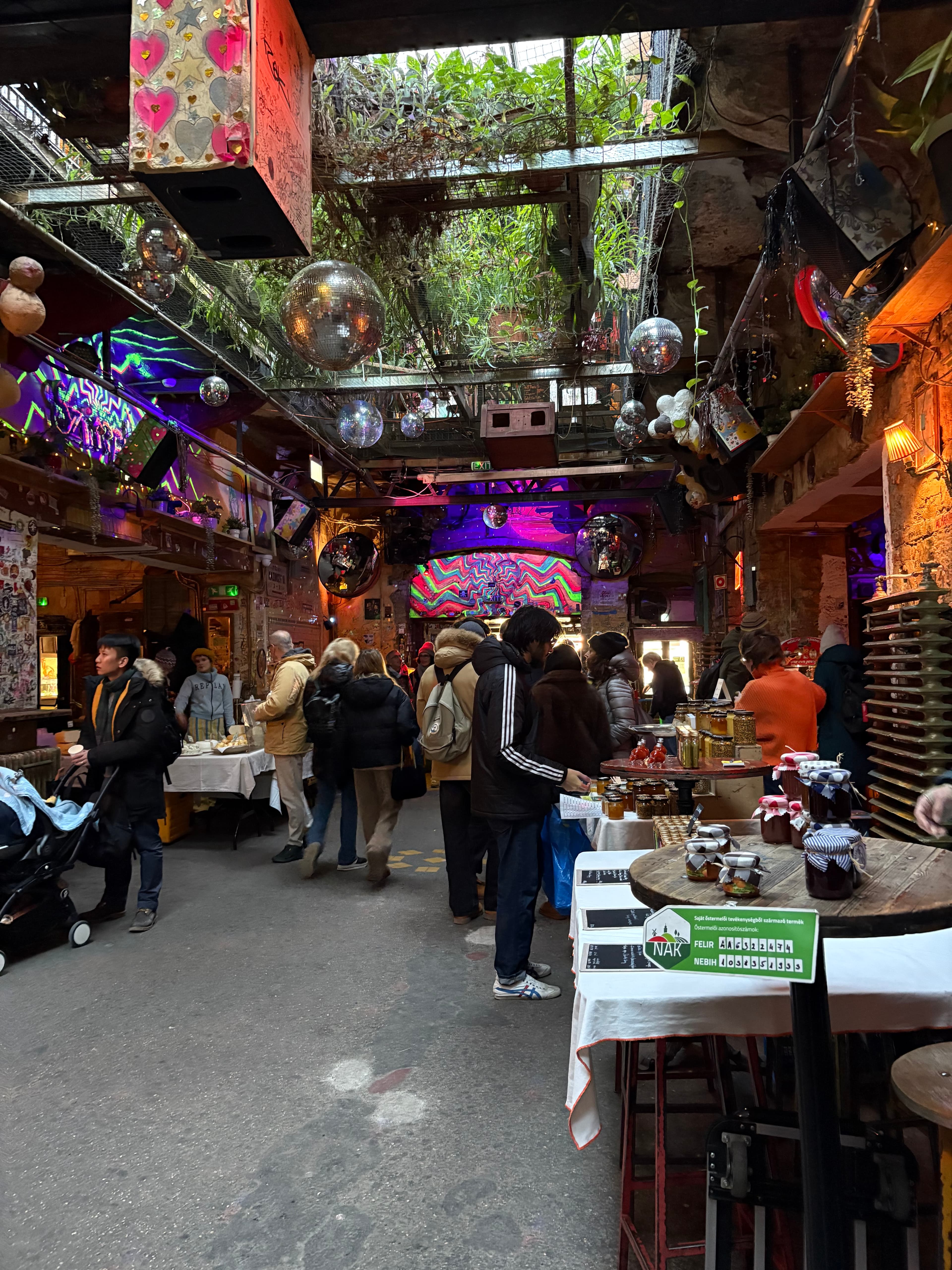
The ruin bars of Pest, perhaps, stood out to me as the city’s most significant way of coming to terms with its tumultuous history — through drinks and loud music (the true European way). On an unassuming street, aligned like all the other streets in Pest similar to New York City’s grids, we took a right past large, translucent double doors that did not betray whatever awaited behind. Just as quickly, we were hit with a whiff of different foods. The first floor of the ruin bar was a farmer’s market every Sunday morning, lined with vendors selling delicatessen, cheessen, sausagessen, and other stuffessen. The alley was reasonably packed, with tourists and locals flocking like gulls to vendors that offered free samplessen. It was here that I met her/him (preferred pronouns, respected). My soulmate. The love of my life. The Promethean flame to my everwinter. Reunited once again. I found cheese.
After I had a dainty portion (read: a whole roll of a soft, smoked cheese, and slices of other hard cheeses), we made our way up to the second floor. Admittedly, I was anticipating more vendors with an assortment of other unique local offerings — I wanted more free samples. As we walked up the flight of stairs, the atmosphere of the area shiftd noticeably. Gone were the amicable vendors proudly displaying their wares and wide-eyed tourists gawking in reciprocation, and in their stead we found aged furniture, overgrown fauna, and signs that there might have been some merry-making the previous night.
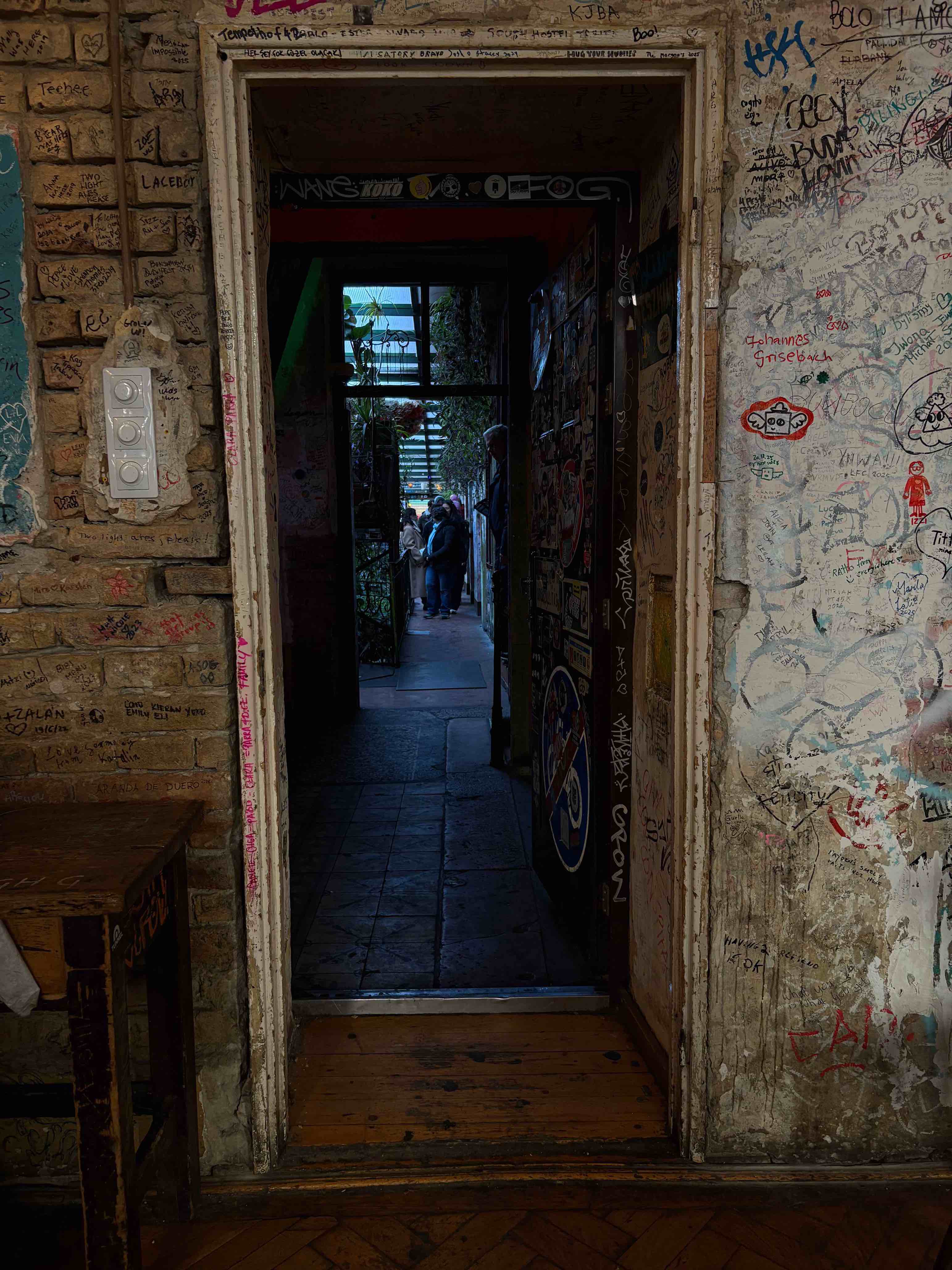
There was significantly more footfall on this second level. People of all sorts were soaking in the view of the famous ruin bars. I, too, in all my faux-sophistication, was just as entranced. This would be a great place to be stabbed. Atmosphere, 10/10. Acoustics for screaming, 8/10, Dampness, 8/10. Do not threaten me with a good time. I could scarce imagine how the bar areas would transform at night (also, I never bothered staying out late enough to find out). Perhaps in another life, or I may just watch a YouTube video about it. Walking around the level was more of the same. Haunting remnants of a time well-past, intermixed with perhaps more recent spats of grafitti-ing. Old furniture, new furniture, and the walking hazard of raucous tourists.
St. Stephen's Basilica
As the evening loomed on a Sunday afternoon, we made our way to St. Stephen’s Basilica for English mass. As we approached the vicinity of the quite-majestic building, I was hit by a wave of fragrances. Though, it was not quite the burning incenses of frankincense and myrrh that one may reasonably expect, but the smells of a thousand foods offered by vendors parked right outside of the Basilica. There was a full-fledged Christmas market that had taken root at the base of the building.
Anyways, there was a bit of a separation between where the Christmas market ended and the steps up to the Basilica began — so one might say there was still a healthy separation of church and state (that IS how the term works, yes?). The entrance to the Basilica was quite packed, both with people attempting to enter, and those trying to leave. As we made our way up the steps, we noticed signs that read “Tickets”. No way. Were they actually charging people to enter the Basilica for mass? Sceptical, and quite incredulous, we decided to push onwards to the attendant’s area — surely an exception was made for faithful Catholics like us who wanted to attend mass (which we all were, for the two hours).
“Hello, tickets please,” the attendant said, with phone in her hand, in a professional yet firm manner. We looked at each other. Whatever, it was worth a shot.
“Oh, we’re here for the mass, do we stilll—“, I started. “Okay, please enter,” she said as she cut me off, now turning to the people behind us. It worked. Jesus was always the answer. We hurriedly made our way into the Basilica before she could change her mind.
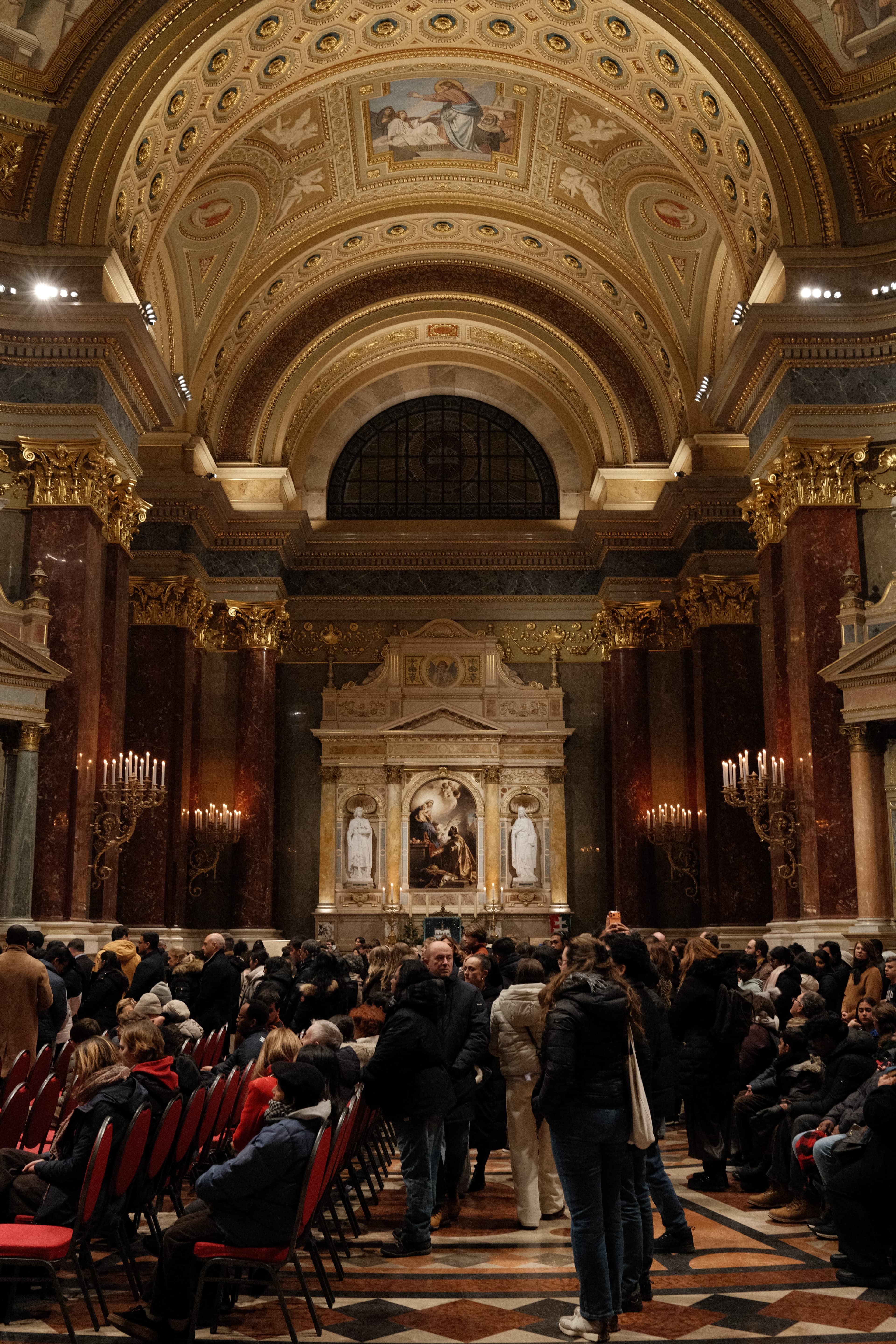
Stepping into the main chamber almost-literally took me back in time — to when I imagined some big-name Saints would have walked the same tiled floor, and stared up at the same jaw-dropping ceiling. Truly, there are few better ways to inspire an intrinsic sense of smallness and awe than by visiting ancient, historical sites (the other way, of course, is to be surrounded by towering Scandinavians). Every inch of Basilica's main area was bursting with rich designs; some (if not most) probably having withstood more than a century of time-wear.
Despite that, what remained most vivid in my mind was not the splendor of the architecture nor the grandness of the carvings, but the congregation of community for weekly mass. As much as this building was historically significant and majestic in its own right, it still continued to faithfully serve its original purpose — as a gathering place for the devout. To me, the true beauty of the Basilica was exemplified through the humble mass, as the marble and concrete reinforced the voices of the people as they sang in unison. That was when the Basilica truly hummed with life.
Departure
As the train pulled away from snowy Budapest on our last day, and as I penned down my experiences (it was between writing this and doomscrolling, and I would have chosen the latter if my connection wasn't so terrible), I could not help but marvel at the sheer amount of history baked into every crevice of the city. Budapest had been struck, rebuilt, struck, then rebuilt, over and over again. Yet, the city wears its scars proudly — finding opportunities to commemorate, celebrate, and honour those that had come before.